Image of students reading together. Reading Logs that Actually work. An In-Class Reading Tracker That Does the Heavy Lifting

Reading Logs That Actually Work: An In-Class Reading Tracker That Does the Heavy Lifting

Hey there, Teacher Friends! Today we are talking about dun, dun, dun…Reading Logs! Traditional reading logs track one thing: time. Time is fine, but time doesn’t tell you if your students understood what they read, made a connection, or could retell the story. What if your in-class reading tracker did the comprehension work at the same time? That’s the idea behind this resource—and once you try it, the old version is going to feel like it’s missing something. The Problem with Traditional Reading Logs (You Know This One) You send one of these bad boys home. Some students return it

Read More »
Image of a teacher and student doing a high five. Text: Star Student: A Simple Classroom Helper System for K-2 (No Job Chart Needed!)

Star Student: A Simple Classroom Helper System for K-2 (No Job Chart Needed!)

Hey there, Teacher Friend! If you’ve ever spent 10 minutes at the start of the day shuffling job cards on your classroom job chart, reminding kids who has what job, or listening to someone sob because they didn’t get “door holder”, this post is for you. What if you could ditch the classroom job chart completely and hand everything to one kid? Okie dokie, friends. Let me introduce you to Star Student—the simplest classroom helper system you’ll ever try. Why I Ditched My Classroom Job Chart Job charts are cute. They really are. But after 23 years in primary classrooms,

Read More »
Image of a boy writing. Text: Classroom Writing Routine for K-2: Fun Writer's Workshop Ideas for Teaching Writing in the Primary Grades

Classroom Writing Routine for K-2: Fun Writer’s Workshop Ideas for Teaching Writing in the Primary Grades

Okay, teacher friends. Let’s talk about writing time, your Writer’s Workshop, your writing block, whatever you call it, it is the time when you are teaching your students how to write. You know that moment when you say “Get out your writing notebooks” and half your class looks at you like you just announced a dentist appointment? Yeah. That’s real. Teaching writing in the primary grades can feel hard—for teachers AND for kiddos. But here’s what I’ve found: when you have a solid classroom writing routine, everything gets easier. Your students know what to expect. You know what comes next.

Read More »
Teaching Observation Skills in Primary Grades and why it matters more than we think.

Teaching Observation Skills in Primary Grades (and Why It Matters More Than We Think)

Hey there, Teacher Friend! If I’m being honest, teaching observation skills wasn’t always something I planned for. It just sort of… happened. (Pssssstttt…keep reading, there is a freebie at the end). At some point, I realized my students were rushing. Through science. Through writing. Through reading pictures, charts, and even directions. They looked, sure. But they weren’t really observing. And that’s when it clicked for me that observation skills don’t magically develop on their own. We have to teach them. Slowly. On purpose. And once you start focusing on observation activities in the classroom, you realize how many things suddenly

Read More »
Journal Writing in elementary school.

Why Journal Writing Is One of the Most Powerful Tools in Elementary Classrooms

Hey there, Teacher Friend! I wanted to talk today about something that has gone a little by the wayside since the introduction of computers in everyone’s classroom: Journal Writing! There’s something about a stack of student journals that just feels… hopeful. Maybe it’s because journals don’t ask kids to be perfect. They don’t rush them. They don’t insist on neat conclusions or fancy endings. And in a primary classroom, that kind of space really matters. Keeping a journal at school gives students a place where their thinking can live. A place to write, draw, notice, reflect, and practice being learners.

Read More »
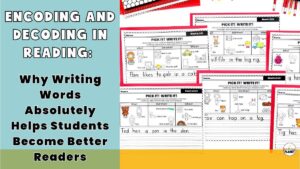
Encoding and Decoding in Reading: Why Writing Words Absolutely Helps Students Become Better Readers

Encoding and Decoding in Reading: Why Writing Words Absolutely Helps Students Become Better Readers

Hey there, Teacher friend! I came across this quote the other day, and it really got me thinking about encoding and decoding in reading. “Reading is like breathing in, writing is like breathing out.” Pam Allyn Table of Contents 1. Encoding and Decoding in Reading: More Connected Than We Think For a long time, I treated encoding and decoding as two separate lanes. Decoding lived in reading instruction. Encoding showed up during writing time. That felt logical… and also very tidy. But once you really start paying attention to how young readers work through words, that separation starts to feel

Read More »
A Teacher's Guide to Teaching Reading Fluency with a Focus on Punctuation.

A Teacher’s Guide to Teaching Reading Fluency with a Focus on Punctuation

Hey there, Teacher Friend! Teaching reading fluency isn’t only about reading faster—it’s about reading with meaning. One of the easiest ways to support this in primary classrooms is by teaching students to pay attention to punctuation and let it guide their voice as they read. Table of Contents Why “Read the Punctuation” Even Matters I’ll be honest. For a long time, I thought punctuation was… fine. Important, sure. But kind of secondary when it came to teaching reading fluency. Then I started listening more closely to my students read out loud. Not skimming. Not decoding silently. Actually listening. And I

Read More »
Elementary student observing a critter. Observation Journals for elementary science.

Observation Journals: How to Bring Real Science into Your Classroom (No Prep Required)

Hey there, teacher friend. Do you love the idea of hands-on science, but sometimes the reality feels a little overwhelming? Between the planning, the supplies, and the cleanup, it’s easy to let science slide to the back burner when the week gets busy. But here’s the good news: you don’t need complicated experiments to help your students think like scientists. In fact, some of the best science learning happens when students simply stop, look closely, and record what they notice. That’s where observation journals come in. They’re simple, no-prep, and surprisingly powerful. Whether you use them during your science block,

Read More »
Image of sequencing activities with transition words. Why Sequencing Matters.

Why Sequencing Matters: Turning Pictures into Powerful Stories

Hey there, teacher friend! Today, I want to talk with you about sequencing, putting things in order, and why you need to teach it to your budding writers (and readers) in your elementary classroom. Why Sequencing Matters in Early Writing When you’re teaching young writers, there’s always that one story that starts with “First we went to the zoo” and ends with “Then we went to bed,” and everything in between is a beautiful blur. Sequencing is one of those foundational skills that helps students make sense of the world around them — and their own writing. It’s how they

Read More »
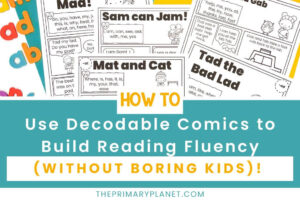
How to Use Decodable Comics to Build Reading Fluency without boring kids.

How to Use Decodable Comics to Build Reading Fluency (Without Boring Kids!)

Hey there teacher friend! Make reading fluency fun. Learn how to use decodable comics to boost phonics skills, confidence, and expression in your K–2 classroom. Why Reading Fluency Practice Often Falls Flat Let’s be honest — we’ve all seen that glazed look students get when you hand them another bland fluency passage. It’s not that they can’t read it. It’s that they don’t want to. Fluency practice can feel repetitive, especially when kids are just decoding words without meaning or joy. But fluency isn’t just speed — it’s accuracy, expression, and understanding. And to build those skills, kids need to

Read More »
Image of The Daily Think on a Smartboard. Moring work ideas that build thinking skills (not just busy work)

Morning Work Ideas That Build Real Thinking Skills (Not Just Busy Work)

Hey there, Teacher Friend! Transform your morning routine with these fun morning work ideas or bell-ringer activities. Keep reading to learn some engaging, independent work routines and low-prep morning work ideas that build critical thinking, vocabulary, and independence in K–2. Why Morning Work Matters in the Primary Classroom Morning work, Bell Ringers, Bellwork, whatever you call it in your classroom, teachers NEED to start the day with a calm, consistent, independent routines that build our students’ skills! Often though, students rush through worksheets just to get done and then spend their time…wasting time. What we really want are meaningful morning

Read More »
Image of smartboard with a Sentence a Day Disguise a turkey teacher slide displayed. Text: Disguide a Turkey Class : A fun shared writing Thanksgiving Activity.

Disguise a Turkey Class Book: A Fun Shared Writing Thanksgiving Activity

Hey there, teacher friend, let’s talk about November! You know the stretch I’m talking about—Halloween sugar rush has finally worn off, and now we’re racing toward Thanksgiving break. Kids are buzzing, schedules are all over the place with assemblies, and you’re just trying to squeeze in meaningful writing without losing your mind. Been there. Honestly, I think every teacher has. That’s exactly why I’m always on the hunt for activities that keep students engaged, sneak in real writing practice, and feel fun. Because let’s face it—if you say, “We’re going to write another paragraph today,” you’ll get groans. But if

Read More »
Privacy Overview

This website uses cookies so that we can provide you with the best user experience possible. Cookie information is stored in your browser and performs functions such as recognising you when you return to our website and helping our team to understand which sections of the website you find most interesting and useful.