

Hey there, Teacher Friend! I wanted to talk today about something that has gone a little by the wayside since the introduction of computers in everyone’s classroom: Journal Writing!

There’s something about a stack of student journals that just feels… hopeful.
Maybe it’s because journals don’t ask kids to be perfect. They don’t rush them. They don’t insist on neat conclusions or fancy endings. And in a primary classroom, that kind of space really matters.
Keeping a journal at school gives students a place where their thinking can live. A place to write, draw, notice, reflect, and practice being learners. Not just writers. Learners. And that’s where the real power of journal writing shows up.
Some entries will be great. Some will be rushed. A few might just be pictures with one sentence that says, “This is my idea.” But taken together, journals quietly support growth in ways worksheets just can’t.
Why Journals Belong in Primary Classrooms

Journals create continuity. Students don’t have to start over every day with a brand-new paper and a brand-new expectation. The journal becomes familiar. Safe. Predictable.
That’s especially helpful for reluctant writers.
This is where tools like Writing Prompts with Pictures fit so naturally. When students open their journals and see a visual prompt, the thinking starts right away. Even kids who usually say, “I don’t know what to write,” suddenly have something to respond to. The journal stays student-owned, but the support is quietly there.
A journal says:
You can try here.
You don’t have to get it right the first time.
This space is yours.
And when students feel ownership, they’re more willing to take small risks with words. Sometimes bigger ones too.
Journals aren’t Just for Writing Stories
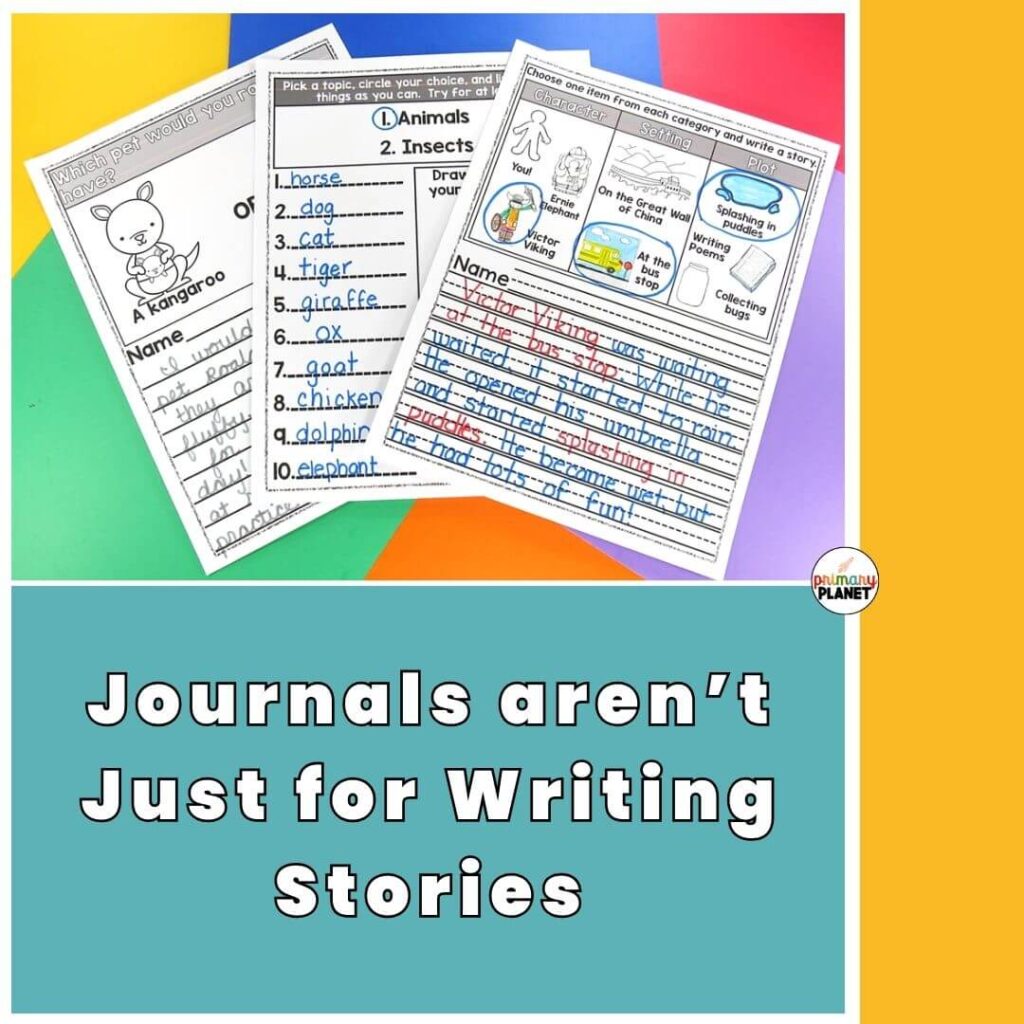
This is one of my favorite things about journals. They don’t need to be limited to one subject or one purpose. In fact, the more flexible they are, the more valuable they become.
Here are several meaningful ways journals can be used in a primary classroom.
1. Daily or weekly journal writing
This is the classic use, and for good reason. A short prompt, a question, or a picture gives students a low-pressure way to practice writing regularly.
Some days, students write a lot. Other days, they don’t. That’s okay. The consistency matters more than the output.
2. Science observation journals
Journals are a perfect fit for science. Students can draw what they see, label diagrams, and write simple observations without worrying about polished sentences.
This is exactly how resources like the Weather Observation Journal, Life Cycle of a Butterfly Journal, and Plant Life Cycle Journal are designed to be used. Students observe first. Then they record what they notice. The writing is purposeful, but still very developmentally appropriate.
3. Reading response journals
Instead of another worksheet, journals give students flexible ways to respond to reading. They might draw a favorite part, write about a character, or make a connection to their own life.
The responses don’t have to look the same, and that variety keeps journal writing from feeling repetitive.
4. Math thinking journals
Math journals are such an eye-opener. When students explain how they solved a problem, draw models, or write what felt tricky, teachers get insight you’d never see from an answer alone.
Even a few words or a labeled picture counts. The goal isn’t perfect explanations. It’s visible thinking.
5. Vocabulary and word collection journals
Journals are a great place for collecting words. New vocabulary from reading, science, or class discussions can live right alongside student writing.
Pairing journal work with a Personal Student Dictionary or Mini Thesaurus gives students a way to hold onto new words and actually use them again later, which is where real growth happens.
6. Social-emotional reflection
Journals can also be a quiet space for reflection. Writing or drawing about feelings, classroom experiences, or problem-solving scenarios helps students process their world.
Not every entry needs to be shared. Sometimes the value is simply having a place to put thoughts.
Journals Grow with Students

One of the most rewarding things about journals is flipping back through them later in the year.
Early pages might be sparse. Later pages often look fuller. More confident. More detailed. You don’t always notice the growth day to day, but it’s there.
And when students notice it themselves? That’s huge.
Final thoughts
Journals don’t need to be fancy. They don’t need to be graded. They don’t need strict rules.
They just need to be used.
When journals are supported with simple tools like picture prompts, observation pages, and word-collection supports, journal writing becomes a natural part of the day instead of one more thing to manage. Want to try out some fun Journal Writing Activities already done for you? Find some fun (FREE) writing activities in my Free Resource Library! Just sign up for my Primary Planet Newsletter and I will send you the password! Click the button to sign up now:
If journal writing hasn’t felt like it’s working, maybe it just needs a little breathing room. Less pressure. More trust. A little mess.
That’s usually where the best learning sneaks in anyway. Pin this post so you have journal writing ideas ready when planning gets busy.

Happy Teaching,
Hilary