Hey there, Teacher Friend! If I’m being honest, teaching observation skills wasn’t always something I planned for. It just sort of… happened.
(Pssssstttt…keep reading, there is a freebie at the end).
At some point, I realized my students were rushing. Through science. Through writing. Through reading pictures, charts, and even directions. They looked, sure. But they weren’t really observing. And that’s when it clicked for me that observation skills don’t magically develop on their own. We have to teach them. Slowly. On purpose.
And once you start focusing on observation activities in the classroom, you realize how many things suddenly get better.

Table of Contents
- What Are Observation Skills, Really?
- Why Observation Skills Matter in K–3
- Observation Activities Across the Day
- Using Observation Journals to Build Skills Over Time
- Simple Ways to Strengthen Observation Skills
- Final Thoughts
- TL;DR
What Are Observation Skills, Really?
Observation skills go way beyond “look at this.”
They’re about noticing details, tracking changes, comparing what you see today to what you saw yesterday, and being able to say, “Hmm… something is different.” That’s a big deal for five-, six-, and seven-year-olds.
In primary grades, observation skills show up when students:
- Notice patterns
- Describe what they see using specific words
- Record information through pictures and labels
- Ask questions based on what they notice
It sounds simple. It is, and it isn’t.
Because most kids will happily tell you what they think something is… before they’ve really looked at it.
Why Observation Skills Matter in K–3
This is where things get interesting.

Strong observational skills support just about everything we care about in primary classrooms. Science, obviously. But also writing. Reading comprehension. Even math.
When students learn to slow down and observe:
- Their writing becomes more detailed
- Their science explanations make more sense
- Their drawings start to include purpose, not just decoration
- Their confidence grows because they know what they’re talking about
I also think observation skills help with attention. Not perfect attention. Real attention. The kind that’s practiced in short, meaningful bursts.
And honestly? That’s huge for K–3 learners.
Observation Activities Across the Day
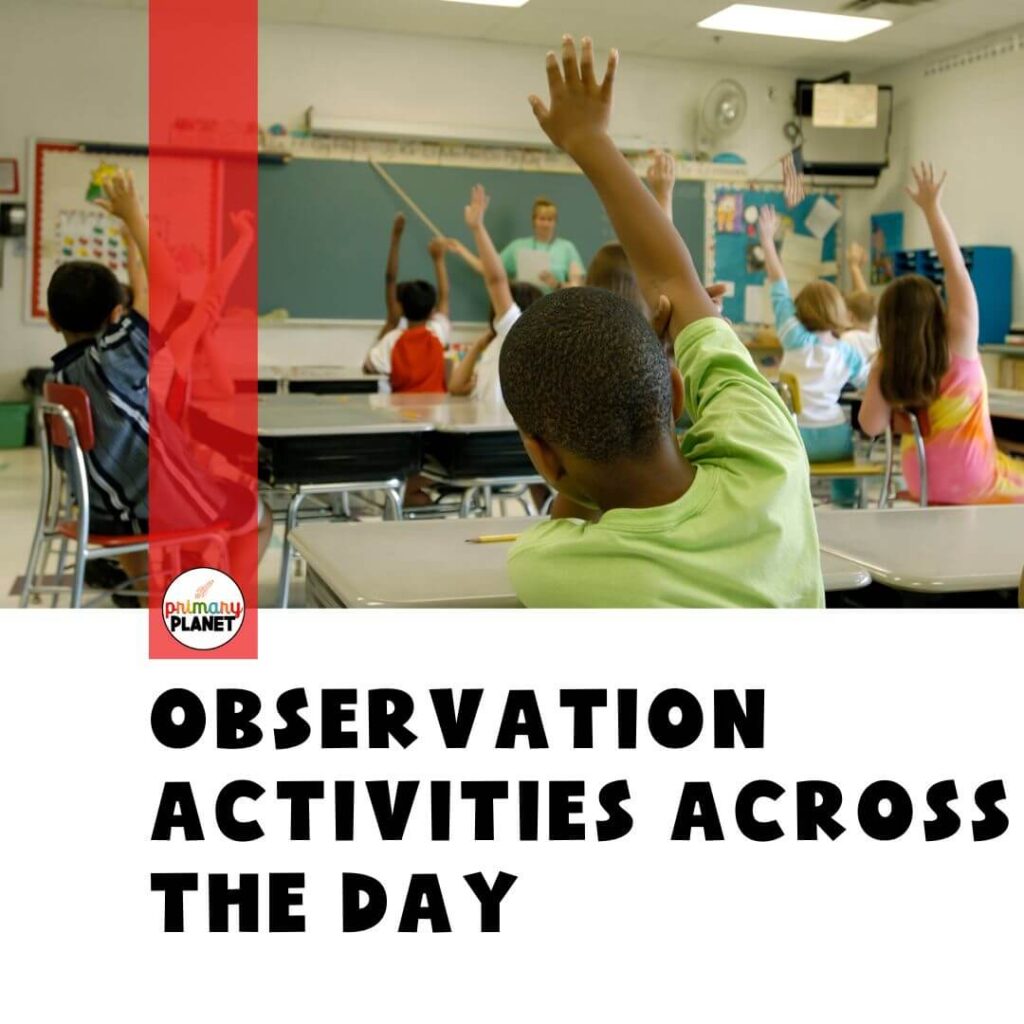
Observation activities don’t have to live only in science time.
Some of my favorite moments happen when observation sneaks into other parts of the day.
Morning work with a picture to study.
A read-aloud where students notice changes in illustrations
Writing lessons that ask students to describe something specific they can see
Quick science check-ins where students record one small change
One of my favorite activities would be to move something (in my room, it was a hanging “Blue Man” from the Blue Man group that I got on a Universal Studios Vacation. I would move him every day, and when the students would come in, they would look for him. No reward involved, just a little observational fun!
These moments add up. And over time, students start approaching learning with a little more patience. A little more curiosity.
They stop guessing as much. Not entirely. But less.
Using Observation Journals to Build Skills Over Time
This is where observation journals really shine.
One-off observation activities are great, but journals help students build observation skills over time. They show growth. They encourage reflection. And they give students a safe space to try.
In my classroom, journals became a routine. Not fancy. Not perfect. Just consistent.
For weather studies, I used a Weather Observation Journal that gave students space to draw, record, and notice patterns over days and weeks. Watching students slowly move from “It is sunny” to “The clouds are thin and white today” was kind of amazing.
When we studied life cycles, observation became even more powerful. The Life Cycle of a Butterfly Journal helped students focus on change. Real change. Not imagined change. They recorded what they saw, even when it felt repetitive. Especially then.
And with plants, our skills really deepened. The Plant Life Cycle Journal encouraged students to notice growth that didn’t always feel dramatic. Tiny changes. Slight differences. The kind kids often miss unless we slow them down.
What I loved most was that these journals didn’t rush students. They invited patience.
Simple Ways to Strengthen Observation Skills
You don’t need a brand-new unit to teach observation skills.
A few small shifts can make a big difference:
- Ask “What do you notice?” before “What do you think?”
- Give time to look before time to talk
- Encourage drawing before writing
- Let students revisit the same object or idea multiple times
And maybe most importantly… let it be imperfect.
Sometimes observations are wrong. Sometimes they’re incomplete. That’s okay. That’s learning.
Final Thoughts

I think we underestimate observational skills sometimes. They feel quiet. Subtle. Almost invisible.
But when students learn how to observe carefully, they become better thinkers. Better writers. Better scientists. And maybe even better listeners.
At least, that’s what I’ve seen.
And honestly? It’s one of the most rewarding skills to teach.
TL;DR
Observation skills help primary students slow down, notice details, and think more deeply across subjects. Using consistent observation activities and tools like observation journals builds confidence, supports science learning, and strengthens writing and critical thinking in grades K–3.
Want to try adding some more observation activities into your day? Try this free observation journal! Just sign up for my Primary Planet newsletter and get access to my free resource library! Click the button to sign up:
Planning to try more observation activities with your students? Save the image below so you can find this post again—especially if you want to grab the freebie later.

Happy Teaching,
Hilary