


Hey there, Teacher friend! I came across this quote the other day, and it really got me thinking about encoding and decoding in reading. “Reading is like breathing in, writing is like breathing out.” Pam Allyn

Table of Contents
- Encoding and Decoding in Reading: More Connected Than We Think
- How Encoding Supports Decoding (and Vice Versa)
- What Intentional Encoding Looks Like in Primary Classrooms
- Encoding Activities That Strengthen Reading Skills
- Using Pick It! Write It! to Support Encoding and Decoding in Reading
- Final Thoughts
- TL;DR Summary
1. Encoding and Decoding in Reading: More Connected Than We Think

For a long time, I treated encoding and decoding as two separate lanes. Decoding lived in reading instruction. Encoding showed up during writing time. That felt logical… and also very tidy.
But once you really start paying attention to how young readers work through words, that separation starts to feel a little artificial. When students struggle to decode words while reading, they often struggle to encode those same words in writing. And when encoding improves? Decoding usually follows.
That’s when it really hit me: encoding and decoding in reading aren’t separate skills at all. They’re two sides of the same process. One just happens on paper.
2. How Encoding Supports Decoding (and Vice Versa)

Decoding asks students to take print and turn it into sound. Encoding flips that process — students take sounds and turn them into print. When both are taught intentionally, they reinforce each other in powerful ways.
Here’s what encoding strengthens underneath the surface:
- Phonemic awareness
Students must hear each sound clearly in order to write it. That same skill is essential for decoding while reading. - Sound–symbol relationships
Writing words requires students to match phonemes to graphemes again and again. That repetition matters. - Orthographic mapping
Writing decodable words helps spelling patterns stick, which makes those words easier to recognize when reading later. - Confidence with unfamiliar words
Students who are comfortable encoding are often more willing to attempt decoding new words in text.
I’ve seen students hesitate less when reading simply because they’ve written similar words before. Not because someone told them the word — but because they understood how it worked.
3. What Intentional Encoding Looks Like in Primary Classrooms

Encoding doesn’t help reading when it’s random or disconnected. Copying words or filling in blanks without thinking doesn’t strengthen decoding skills.
Intentional encoding means:
- Students write words they can decode
- The focus stays on phonics patterns, not memorization
- Sentence structures are predictable and supportive
- Students reread what they write
When encoding is intentional, it naturally supports decoding. Students are practicing the same skills — just from the opposite direction.
This is especially true at the sentence level. Sentences encourage rereading. They require meaning. And they quietly build fluency without feeling like a reading drill.
4. Encoding Activities That Strengthen Reading Skills

Here are some easy ways to use encoding to support decoding during reading instruction — even outside of traditional writing time.
Sentence Build + Reread
Students write a decodable sentence, then read it multiple times:
- Whisper read
- Partner read
- Read with expression
This builds fluency in a low-pressure way.
Phonics Pattern Highlighting
After writing, students highlight or circle words with the target phonics pattern, then read those words aloud together.
Sentence Sorting
Mix student-written sentences and sort them by vowel pattern or spelling feature. Students must read each sentence to decide where it belongs.
Oral Encoding
Say a sentence aloud. Students repeat it, write it, then read it back. This connects listening, encoding, and decoding in reading all at once.
Sentence Rebuilds
Cut sentences apart and have students rebuild them, then read them aloud. This strengthens decoding and comprehension at the same time.
None of these activities require extra prep — just a shift in how we view encoding.
5. Using Pick It! Write It! to Support Encoding and Decoding in Reading

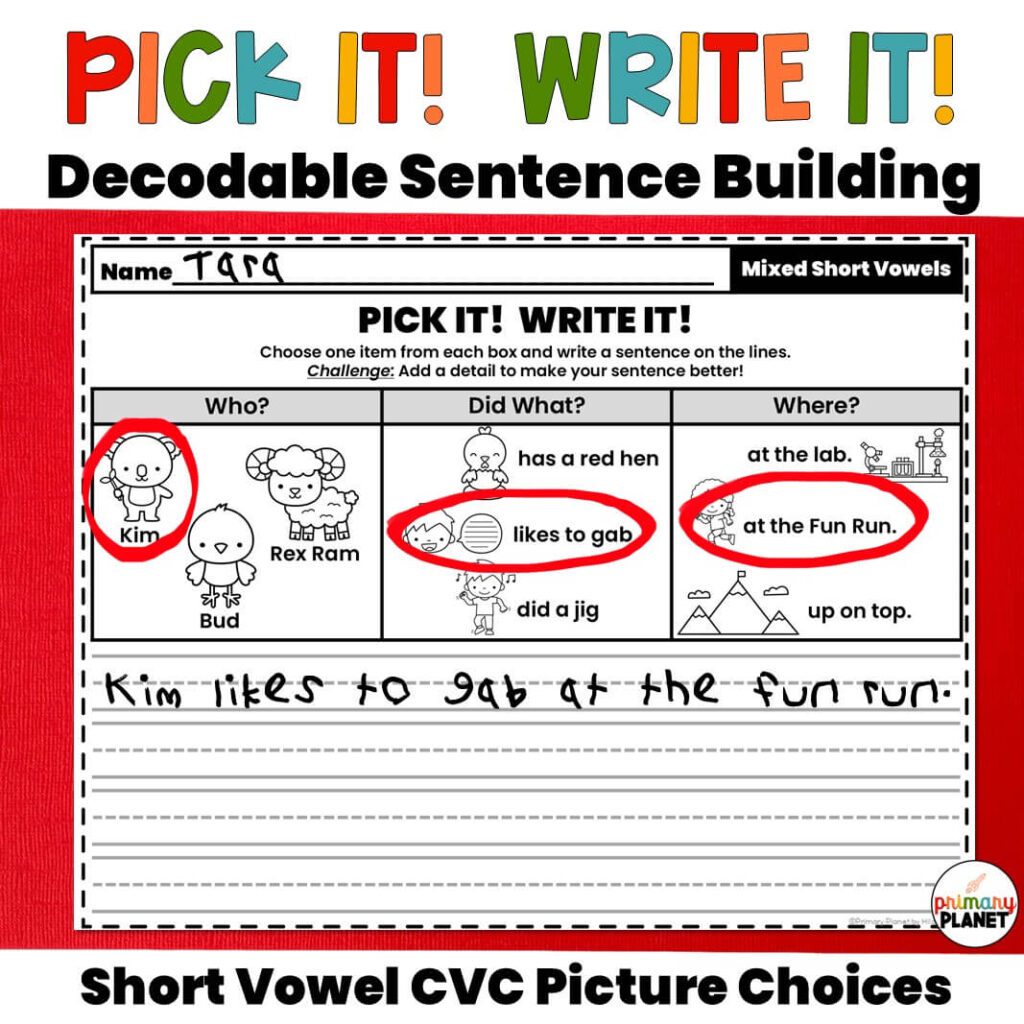
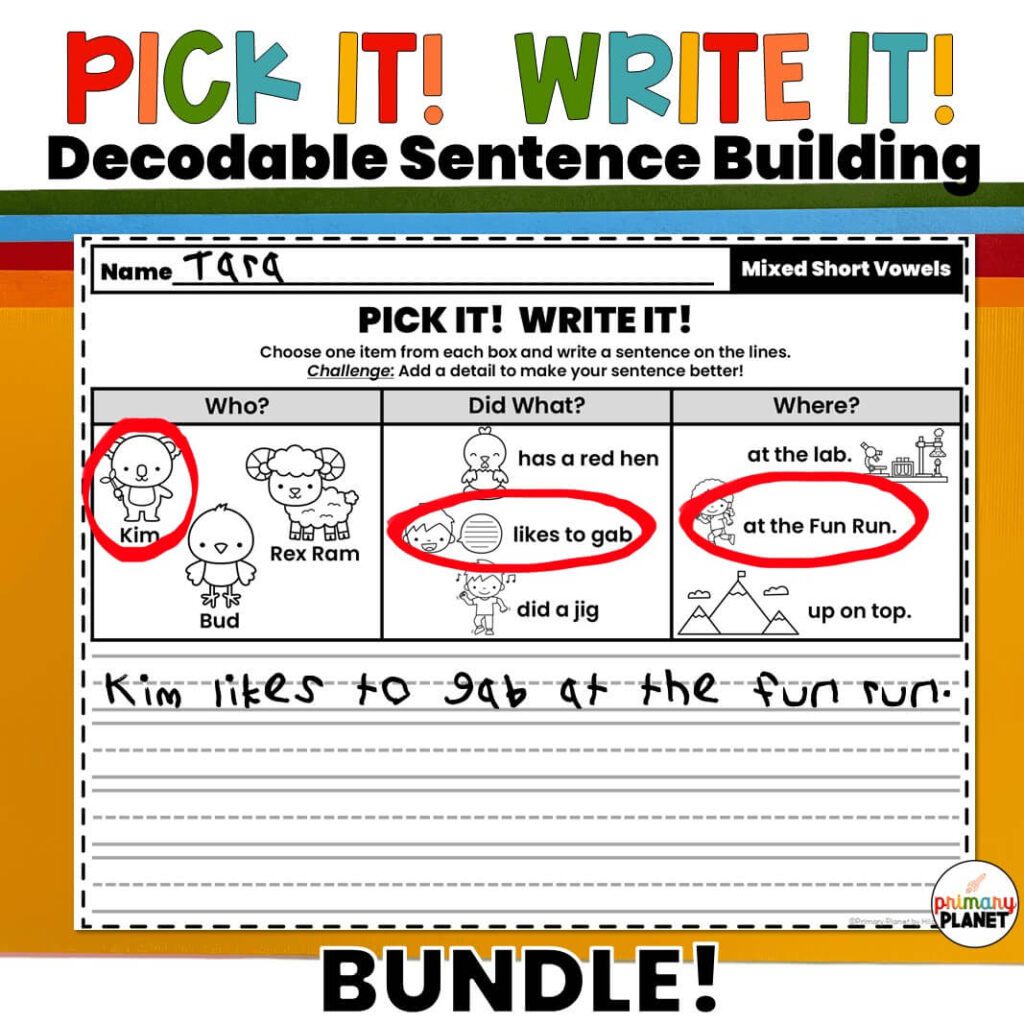
This is where Pick It! Write It! fits in so naturally. The resource is designed around structured, decodable sentence writing, which makes it ideal for strengthening encoding and decoding in reading.
Students:
- Choose from decodable word options
- Build meaningful sentences
- Write what they can decode
- Reread what they wrote
That read–write–reread loop is exactly what supports decoding growth.
Because the structure stays consistent, students can focus on phonics patterns instead of directions. It works well for small groups, literacy centers, or independent practice — and it supports reading skills without adding another separate activity to your day.
-

Decodable Sentence Writing – Short Vowels – Sentence Building Worksheets
$5.75 -
Decodable Sentence Writing Prompts – Digraphs – Phonics Worksheets – Encoding
$5.00 -
Decodable Sentence Writing Worksheets – Phonics Skills BUNDLE – Encoding Practice
$38.25 -
Sentence Writing Worksheets – FLSZ Rule and -CK – Decodable Sentence Building
$4.00
6. Final Thoughts
Encoding is sometimes treated as “extra,” when really, it’s essential. When students learn to write words by sound, they gain insight into how words work. That understanding carries directly into reading.
Encoding and decoding in reading don’t compete for time. They support each other.
And when encoding is intentional, decodable, and meaningful, it becomes one of the most effective — and underrated — tools for building strong readers.
7. TL;DR
- Encoding and decoding in reading are deeply connected skills
- Writing decodable words strengthens decoding, fluency, and confidence
- Sentence-level encoding encourages rereading and comprehension
- Pick It! Write It! supports intentional encoding that naturally boosts reading skills. Want to try Pick it! Write it! for free? Click the button to sign up for The Primary Planet Newsletter and get access to my Free Resource Library! You will find a ton of great freebies, including a Pick it! Write it!
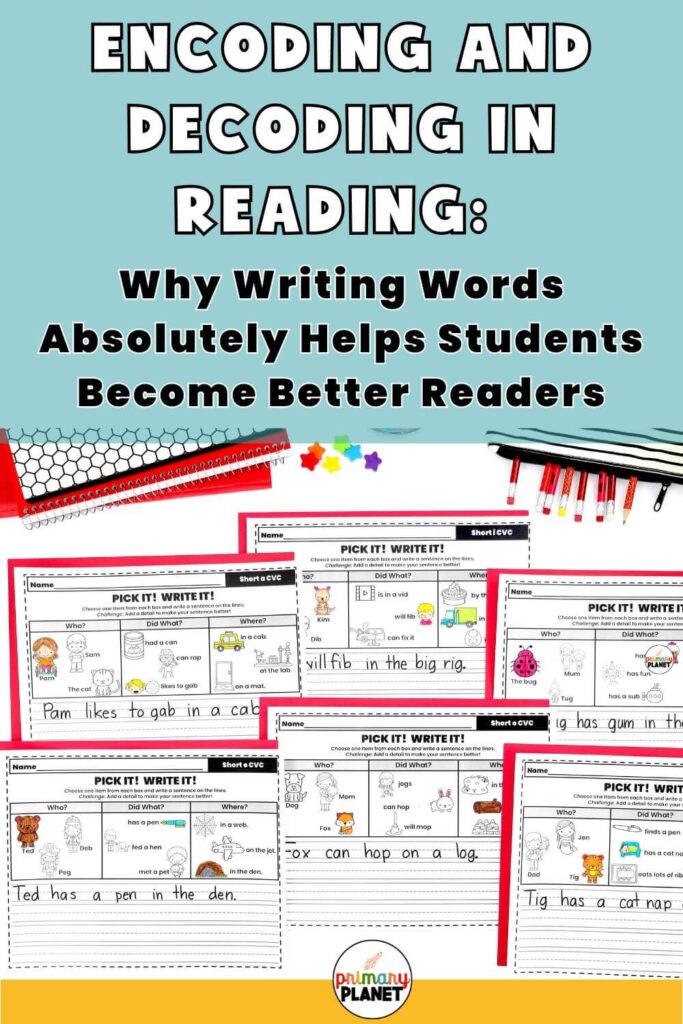
Planning literacy instruction can get busy fast. Pin the image below as a reminder of how encoding can support reading growth.
Thanks so much for stopping by to read my post! Happy Teaching,