
Let’s talk about something that doesn’t always get the spotlight in early literacy instruction—but totally should: encoding.
It’s one of those terms that might sound a little technical at first, but once you understand it, it starts to pop up everywhere. And if you’re teaching young students how to read, write, and spell, it’s something worth paying attention to.
So, what is it exactly? And why does it matter so much for things like sentence writing and decodable sentences?
Let’s dig in. And I promise, no jargon overload.

What Is Encoding?

In the simplest terms, encoding is the process of taking sounds and turning them into written words.
That’s it.
If a student hears the word cat, stretches it out to /k/ /a/ /t/, and then writes C-A-T—that’s encoding.
It’s how children apply their phonics knowledge to write down what they hear. While decoding helps students read, encoding helps them spell.
The two go hand-in-hand. Like peanut butter and jelly. Or dry-erase markers and whiteboards. You get the idea.
Why it Matters in the Primary Grades

In the early elementary years—kindergarten, first, and second—kids are learning the foundational skills they’ll use for the rest of their academic lives. We often focus a lot on reading, which makes sense. But writing needs just as much love. Especially writing that’s rooted in sound-to-symbol relationships.
That’s where encoding comes in.
When students practice encoding, they’re not just writing—they’re thinking about:
- The sounds in words
- The letter patterns that represent those sounds
- The structure of English spelling
- And how to put it all together into a readable sentence
Encoding turns passive phonics knowledge into active application.
It’s one thing to recognize the word “ship” in a decodable book. It’s another thing entirely to write it from scratch. That effort to recall, blend, and spell sounds—that’s where real learning happens.
What Happens When It Is Missing?
Here’s a common classroom scenario I’ve seen and heard about again and again:

A student reads fluently during small-group time. She breezes through decodable books. But then, during writing time, she writes something like:
“Th kat went too the prk.”
She gets the idea. But the encoding piece—the ability to translate sounds to letters—isn’t there yet. And it shows up in her writing.
This doesn’t mean the phonics instruction isn’t working. It just means it hasn’t transferred into writing yet. And that’s where encoding-focused practice comes in.
By giving students daily opportunities to write using the phonics patterns they’re learning, we help strengthen those pathways. It reinforces reading. It builds spelling confidence. It improves sentence structure.
And honestly, it gives kids a way to express themselves with more independence. Win-win.
The Role of Decodable Sentences
So, how do you teach writing in a way that’s developmentally appropriate and not overwhelming?
One of the most effective (and simplest) ways is through decodable sentence writing.
Decodable sentences are made up of words that students can spell using phonics patterns they’ve been taught. They’re like the training wheels of writing. Safe, structured, and perfectly pitched for beginning writers.
When students write decodable sentences, they’re practicing:
- Encoding (spelling by sound)
- Sentence structure (capital letters, punctuation, order)
- Grammar and syntax (without having to guess at hard-to-spell words)
It’s all connected. And it works best when the sentences are student-generated—not just copied from the board or memorized.
A Simple Structure That Supports Encoding
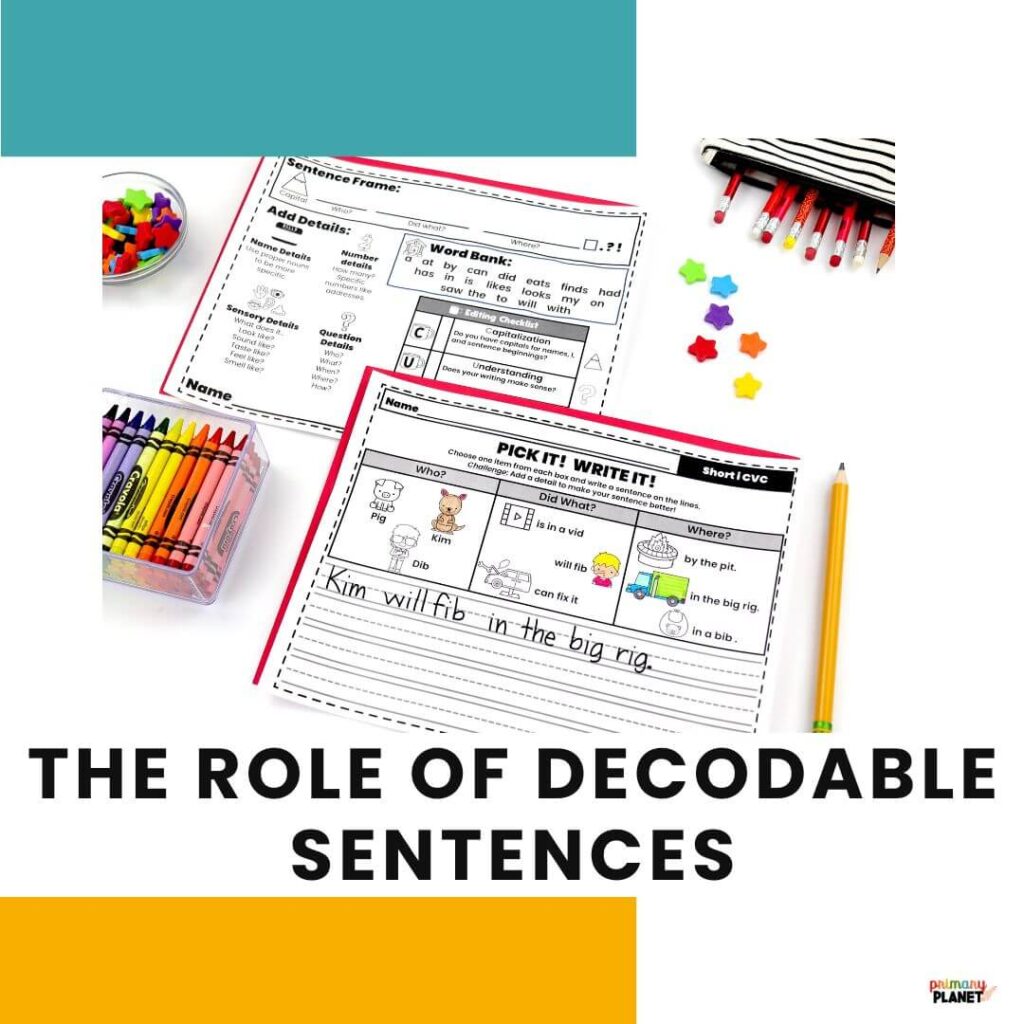
To make encoding practice more accessible and even a little fun, I created a resource that walks students through building their own decodable sentences.
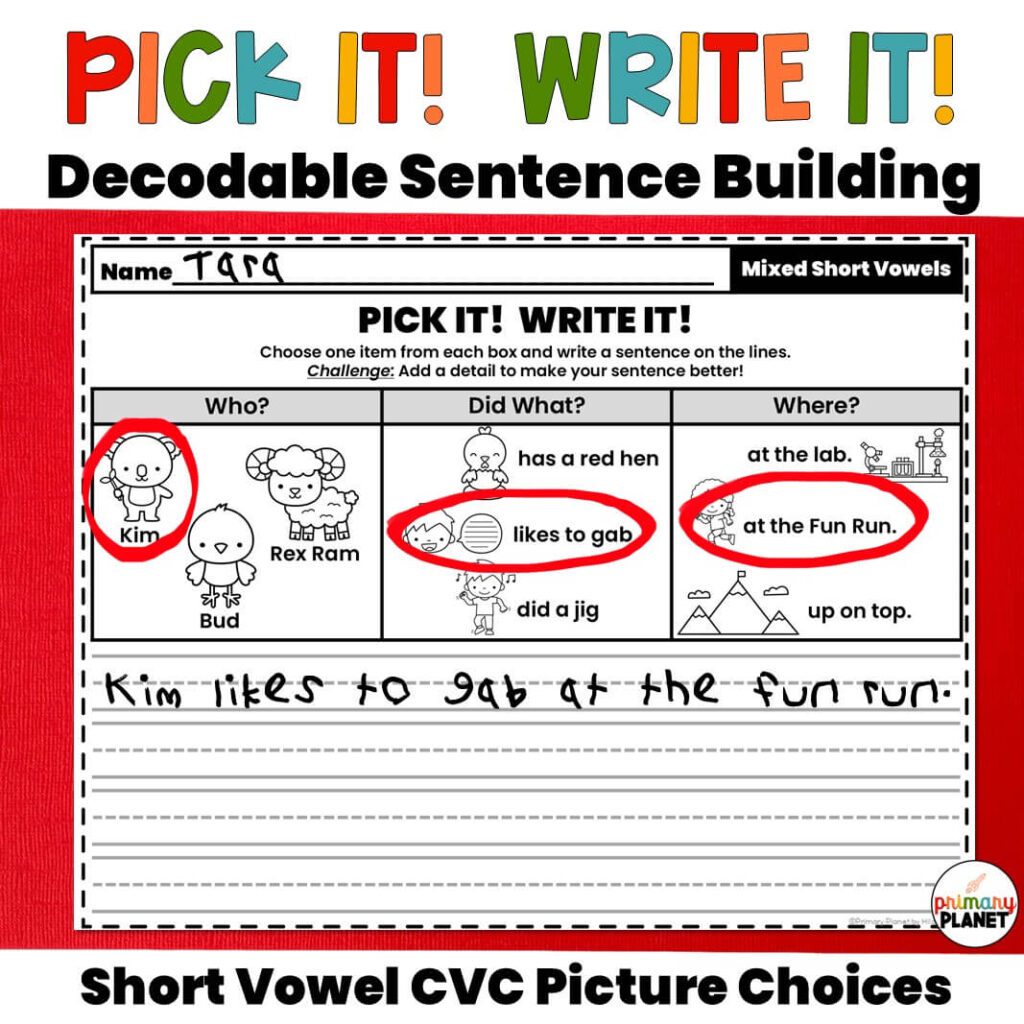
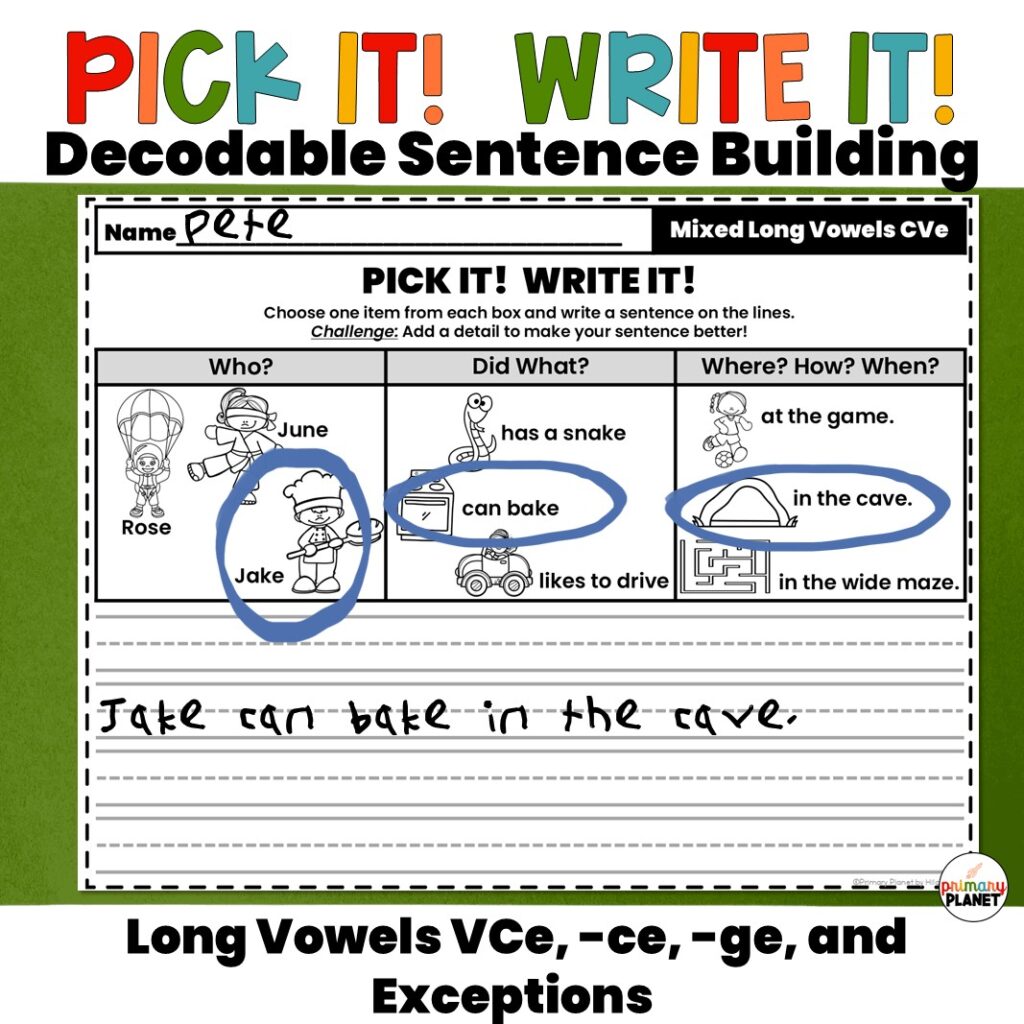
These worksheets help students craft complete sentences by choosing from three columns:
- Who? (characters)
- Did What? (actions)
- Where? When? Why? or How? (settings or details)
Students select one phrase from each column, combine them to build a sentence, then write it independently. Every word is phonics-friendly and intentionally chosen to be decodable for early readers.
Some examples might be:
- “Bud did a jig up on top.”
- “Rose likes to drive at the game.”
- “Nick found a pink sock on the ship.”
Silly? Yes. Decodable? Absolutely. Fun? That’s the goal.
These sentences give students authentic practice with encoding, while supporting sentence structure and even fluency. Because when they read their sentence aloud after writing it—they’re reinforcing decoding and comprehension at the same time.
Why This Works (Even if It Feels Basic)

Sometimes we assume sentence writing needs to be more complex. But here’s what I’ve seen time and time again: simple, structured practice leads to confidence and independence.
Young writers don’t need elaborate writing prompts or pages of grammar rules. They need small wins.
They need to write a sentence and say, “I did that. I spelled those words by myself.”
That pride builds momentum.
And once they’ve mastered decodable sentence writing? You can start introducing more complex vocabulary, sight words, or creative writing extensions. But only after they’ve built a solid encoding foundation.
Want to Try a Free Sample?
✨ If you’d like to give my Sentence Writing Building Worksheets a try, check out the freebie!
Just join The Primary Planet Newsletter and you’ll get:
- Free Sample of Short-Vowel Pick it! Write it!
- Teaching tips for using it in your classroom
- A weekly dose of fresh teaching ideas, resource updates, and happy-teacher encouragement
- Access to my Free Resource Library with a TON of great freebies for your classroom!
It’s low-prep, high-impact, and perfect for first and second grade writers.
TL;DR (Because Teachers Skim Too)

- Encoding = writing the sounds students hear. It’s essential for spelling and sentence writing.
- It works alongside decoding to support reading and writing fluency.
- Decodable sentences give students accessible, structured practice with encoding.
- Sentence Writing Building Worksheets help students build confidence while practicing phonics, grammar, and fluency—all in one spot.
- Join the newsletter to get a free sample and try it in your classroom!
Supporting young readers and writers doesn’t have to be complicated. With a clear focus on encoding—and a little help from decodable sentence writing—you can give your students the tools they need to become confident, capable communicators.
As a teacher-author, it’s my mission to create resources that actually work in real classrooms. I hope this one helps you simplify your instruction and bring more joy to your writing block.
Pin the image to share this valuable information! Sharing is caring. Thank you so much!

Happy Teaching,