How to Use Student Partners to Boost Classroom Collaboration and Increase Achievement

How to Use Student Partners to Boost Classroom Collaboration and Increase Achievement

Sometimes, the best ideas come from the kid sitting next to you. I still remember watching two second graders hunched over a whiteboard, completely engrossed in a spelling challenge. One of them tapped out the sounds slowly while the other scribbled with a dry-erase marker, correcting and cheering along the way. That moment stuck with me—not just because it was adorable (which it absolutely was), but because something important was happening: real, meaningful learning through collaboration. That’s what “thinking partners” are all about. And while I may not be in the classroom anymore, I still think about those partnerships. A

Read More »
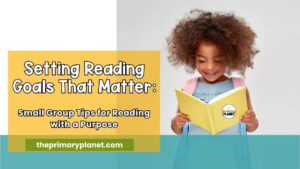
Setting Reading Goals that Matter: Small group tips for reading with a purpose.

Setting Reading Goals That Matter: Small Group Tips for Reading with a Purpose

Let’s talk reading goals (but in a way that makes sense for actual classrooms) Reading goals often sound bigger than they are. I don’t know about you, but when I first heard the phrase “set individual reading goals with your students each week,” my brain immediately flashed to endless checklists, mountains of sticky notes, and me—somehow—keeping track of 24 unique goal paths. That’s a lot. Too much, really. But the more I worked with small groups and thought about what reading goals should be, the more I realized they don’t need to be flashy or overly formal. They just need

Read More »
Image of happy kids. Text: Engaging Synonym and Antonym Activities for first and second grade.

Engaging Synonym and Antonym Activities for First and Second Grade

Teaching vocabulary can be surprisingly tricky. I mean, how do you explain that “mad” and “angry” are basically the same—but not always interchangeable? Or that “hot” and “cold” are opposites, except when we’re talking about personalities? Vocabulary is slippery like that. But, when it comes to building strong readers and writers in the primary grades, we can’t ignore it. Introducing synonym and antonym activities in first and second grade can make a noticeable difference in how students comprehend texts and express themselves clearly in writing. And the good news? It doesn’t have to be boring. In fact, it shouldn’t be.

Read More »
The Secret to Teaching Writing in Kindergarten: How Sentence Building Worksheets Boost Early Writing Skills

The Secret to Teaching Writing in Kindergarten: How Sentence Building Worksheets Boost Early Writing Skills

Teaching writing in kindergarten isn’t easy. If you’re here, you probably already know that. You’ve seen it firsthand—the blank stares, the letter reversals, the “I don’t know what to write” moments. It’s all part of the process. But what if we had a way to ease students into writing without the frustration?A way to build skills step-by-step, while giving young learners the structure and support they need? That’s exactly what I set out to create with my Pick it! Write it! Decodable Sentence Building Worksheets, a printable resource designed to support developing early writing skills in a small group setting.

Read More »
Image of teacher teaching in a small writing group with students. TExt: Teaching writing in small groups and what are the other students doing?

Teaching Writing in Small Groups (and What the Other Kids Are Doing While You Do It)

Let’s be honest: the idea of teaching writing in small groups sounds amazing. In theory. The kind of thing you jot down on a PD day with a hopeful little star next to it—right before the real-world questions start swirling. Like:“But how do I fit it in?”“What will the rest of the class be doing?”“Is it even possible to keep it quiet enough to focus?”And the kicker:“Will this actually help my students become better writers, or is it just another thing to manage?” Yep. I’ve had all of those thoughts. Probably more than once. But I’ve also seen—and created—some truly

Read More »
Image of a young girl writing. Text: You teach phonics, but are you missing a key step? Hint: It's encoding.

You Teach Phonics… But Are You Missing This Key Step? (Hint: It’s Encoding)

Let’s talk about something that doesn’t always get the spotlight in early literacy instruction—but totally should: encoding. It’s one of those terms that might sound a little technical at first, but once you understand it, it starts to pop up everywhere. And if you’re teaching young students how to read, write, and spell, it’s something worth paying attention to. So, what is it exactly? And why does it matter so much for things like sentence writing and decodable sentences? Let’s dig in. And I promise, no jargon overload. What Is Encoding? In the simplest terms, encoding is the process of

Read More »
Image of teacher on the computer. Post about collaborative planning in teaching. Text: Easy Teacher Hack: Lesson Planning with your teaching team using google slides.

Easy Teacher Hack: Lesson Planning with Your Teaching Team using Google Slides!

Collaborative Planning Made Easy! Hey there, Teacher Friend! Lesson planning is one of the most critical aspects of teaching, but it’s often time-consuming and stressful—especially when working with a team. Between juggling emails, scattered resources, and trying to stay organized, the process can feel overwhelming. But it doesn’t have to be this way! Enter Google Slides: a tool that can revolutionize how you approach collaborative planning in teaching. Let’s explore how this idea can simplify your process, solve common problems, and make planning with your team more productive and enjoyable. Problems with Collaborative Planning in Teaching If you’ve ever worked

Read More »
Image of Narrative Writing Pass the Page. Text: Story Writing Games Make Narrative Writing Fun and Engaging!

Story Writing Games Make Narrative Writing Fun and Engaging!

Hey there! Story writing games can transform your students’ narrative writing experience, making it easier, more engaging, and a whole lot of fun. Do your students ever stare at a blank page, wondering how to start their stories? Or maybe they have amazing ideas but struggle to organize them into a clear beginning, middle, and end? It’s a common challenge, but it doesn’t have to be! Let’s explore how story writing games can help make narrative writing easier, more engaging, and a whole lot of fun for your young writers. Plus, I’ll share a resource that transforms storytelling into an

Read More »
Image of teacher teaching in front of a class. Text: Whole Group

Whole Group Reading Strategies and Phonics Instruction for Early Learners

Hey there, Teacher friend! Whole group reading strategies are essential for building foundational literacy skills in first and second-grade classrooms. Whether you are a new teacher setting up your routines or a veteran educator looking for fresh ideas, effective whole-group phonics instruction can make your lessons engaging and impactful. The Importance of Whole Group Phonics Instruction Whole group phonics instruction allows teachers to introduce and reinforce key phonics skills for developing reading fluency. Teaching all students together ensures everyone gets the same exposure to important concepts, creating a strong foundation for further learning. Whole Group Reading Strategies for Phonics Success

Read More »
Image of student reading. Text: Helping students build strong foundational reading skills.

Helping Students Build Strong Foundational Reading Skills

Hey there, Teacher Friend! We know that teaching early readers to decode can be challenging. But, mastering foundational reading skills is vital for students as they build fluency and comprehension. Whether you have been around for a while or are just beginning your teaching journey, finding effective and engaging resources for this learning stage is essential. Supporting Struggling Readers Students often struggle to distinguish between short vowel sounds, such as “a” in “cat” and “e” in “pen.” These subtle differences can be difficult for young learners to grasp, especially when phonics practice feels repetitive or disconnected from meaningful content. Additionally,

Read More »
Image of classroom screen with CUPS editing checklist. Text: Helpful Step-by-Step Writing Mini-Lessons for Teaching Editing Sentences

Helpful Step by Step Writing Mini-Lessons for Teaching Editing Sentences

Hey there, Teacher Friend! Is it time to teach editing sentences? When it comes to improving student writing, one of the most essential skills is editing. But what is editing, and why do students need to edit their own writing? Editing involves reviewing written work to correct grammar, punctuation, spelling, and sentence structure. While it sounds straightforward, many young writers struggle with this skill. Learning to edit not only helps improve the quality of their writing but also teaches students to be reflective and more thoughtful about their work. However, students often find it challenging to look at their own

Read More »
Image of an adorable little boy in glasses writing in a notebook. Text: Effective Writing Warm-Ups! Fun Pre-writing activities for students.

Effective Writing Warm-Ups: Fun Prewriting Activities For Students

Hey there, teacher friend! Do you struggle to find practical prewriting activities to do with your elementary school kiddos? Getting students to start writing can be a challenge. It often takes time and energy to get them focused and ready to put their ideas on paper. That’s where writing warm-ups come in. Writing warm-ups are short, focused activities designed to get students thinking, brainstorming, and preparing for more structured writing tasks. Whether you’re using them as part of your morning work, whole class writing lessons, or small group writing learning activities, these warm-ups can help students engage their minds and

Read More »
Privacy Overview

This website uses cookies so that we can provide you with the best user experience possible. Cookie information is stored in your browser and performs functions such as recognising you when you return to our website and helping our team to understand which sections of the website you find most interesting and useful.