

Teaching vocabulary can be surprisingly tricky. I mean, how do you explain that “mad” and “angry” are basically the same—but not always interchangeable? Or that “hot” and “cold” are opposites, except when we’re talking about personalities? Vocabulary is slippery like that.

But, when it comes to building strong readers and writers in the primary grades, we can’t ignore it. Introducing synonym and antonym activities in first and second grade can make a noticeable difference in how students comprehend texts and express themselves clearly in writing.
And the good news? It doesn’t have to be boring. In fact, it shouldn’t be.
Let’s dig into some practical, playful strategies for teaching these important concepts—plus a few little tools that have helped bring these lessons to life for me and other teachers I know.
Why Teach Synonyms and Antonyms Activities in Early Elementary?

Okay, so let’s be honest—most kids don’t need to know the word “synonym” to use them. They do it naturally. A child might say, “I’m happy!” one day and “I’m excited!” the next. But explicitly teaching them the concept? That’s where the magic happens.
Teaching synonyms and antonyms strengthens:
- Reading comprehension: Students can infer meaning from context more effectively when they recognize word relationships.
- Writing fluency: It reduces repetition. I’ve seen students go from “The big dog ran to the big house with a big stick” to something much more colorful—just by exploring synonyms.
- Speaking and listening skills: Synonyms and antonyms help students express themselves more precisely, and understand others more clearly.
And for many first and second graders, the words “same” and “opposite” are easier to grasp than “synonym” and “antonym,” at least at first. So that’s often where I’d recommend starting.
Introduce with Movement: Partner Match-Up

One of my favorite ways to introduce or review synonyms and antonyms is with partner activities. There’s something powerful about combining vocabulary practice with movement—especially for wiggly learners.
You might use something simple like:
- Partner cards: Hand out cards with either a synonym or an antonym and have students walk around the room to find their match.
- For example, one student might have “happy,” another “glad.” Or “wet” and “dry.”
- Once they find their match, have them use both words in a sentence together.
Yes, I do have ready-to-print Synonym Partner Cards and Antonym Partner Pairing Cards in my shop if you want something grab-and-go. But even index cards or sticky notes work in a pinch.
Sometimes I’d even add a bit of drama: “You must find your opposite before the timer runs out!” The urgency makes it extra fun.
Anchor Charts That Grow with Your Lessons
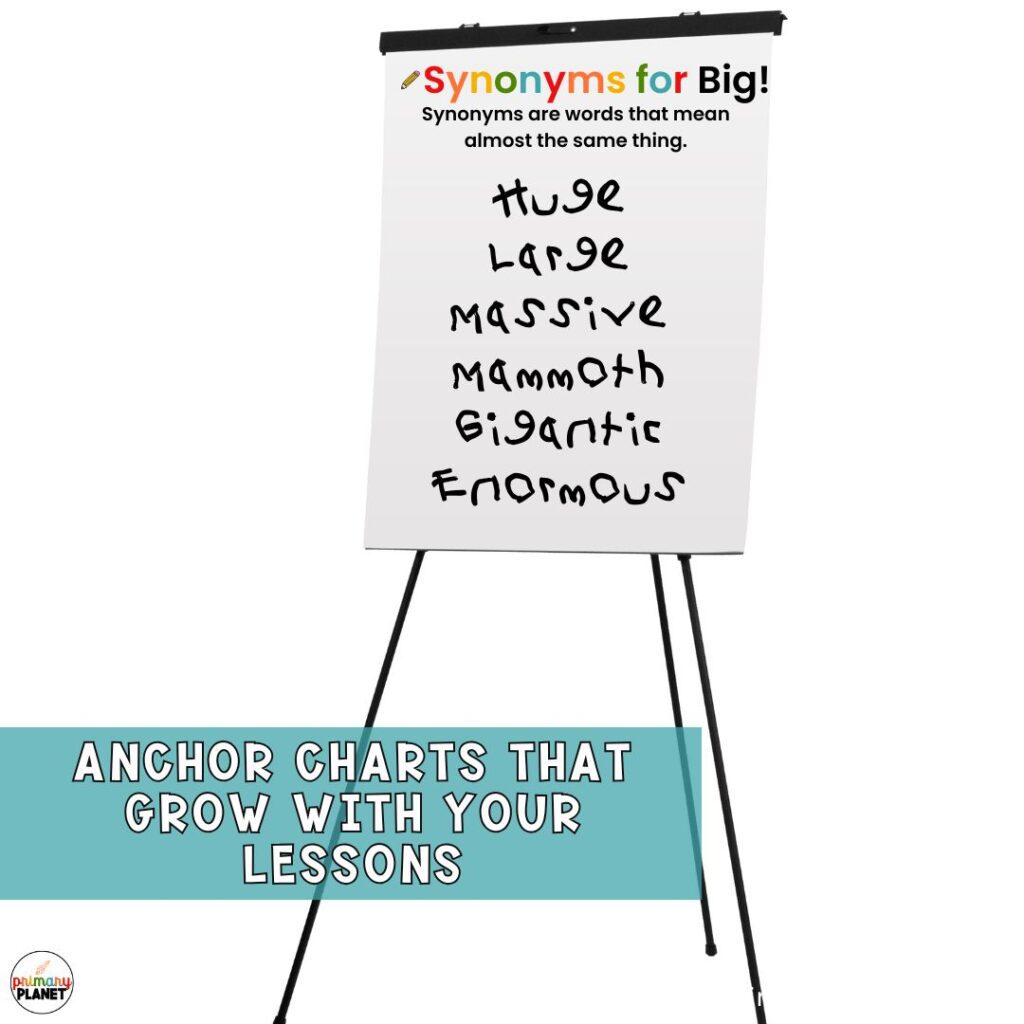
I’ll admit, I’m an anchor chart fan. Maybe too much. But for synonym and antonym activities, they can be super helpful—especially if you create them alongside your students.
Start with a chart labeled “Synonyms for Said” or “Antonyms for Hot,” and grow the list over time as new words come up in books, conversations, or writing. You don’t have to fill the chart in one go.
The best part? When kids start adding to the charts on their own. It doesn’t happen right away, but it’s a clear sign that the concept is sticking.
Use Picture Books to Make Connections

There’s just something about a good picture book. They naturally lend themselves to synonym and antonym instruction if you’re intentional about it.
Try this:
- Choose a book with expressive language. Think: The Word Collector by Peter H. Reynolds or Thesaurus Rex by Laya Steinberg.
- Before reading, pick a few words from the text that you want to highlight.
- As you read, pause to ask, “What’s another word that means the same as ___?” or “What’s the opposite of ___?”
I found that students often give surprising answers—sometimes more advanced than I’d expect. And sometimes, completely off the wall. But that’s part of the process.
Create a “Wow Word Wall”
Instead of just listing high-frequency words, why not showcase synonyms?
Start with a basic word in the middle—like big. Then surround it with more precise or exciting words: huge, gigantic, enormous, vast. The visual web format helps students see how words connect.
As a challenge, ask students to “upgrade” their writing by choosing one of the Wow Words instead of the usual. It’s kind of like a vocabulary makeover. They love it!
Play Synonym and Antonym Games (Because Learning Can Be Loud)

Not every vocabulary activity needs to be quiet. In fact, some of the most effective ones are delightfully noisy. A few favorites:
- Synonym Charades: A student acts out a word, and the others guess its synonym.
- Opposite Corners: Label opposite sides of the room with “Synonym” and “Antonym.” Read a pair of words aloud, and students move to the correct corner.
- Synonym/Antonym Switch: Students stand in a circle. You call out a word, and they say either a synonym or antonym aloud, depending on your signal (like “thumbs up for synonym, thumbs down for antonym”).
These quick, low-prep activities are perfect for transitions, brain breaks, or even sub plans.
Practice in Writing (Even Just a Little)
Sometimes, the real trick is getting students to use synonyms and antonyms in their actual writing. You know, beyond the lesson.
A few ways to encourage it:
- Sentence swaps: Take a basic sentence and rewrite it using a synonym or antonym. (“The dog was big” becomes “The dog was enormous.”)
- Synonym search: After students finish a journal entry, have them highlight any words they could swap out for a more descriptive synonym.
- Writing prompts: Use prompts that ask students to describe something using at least three synonyms or contrast two ideas using antonyms.
Do they always remember? No. But over time, these little nudges start to show up in their writing. It’s subtle but real.
TL;DR: Synonym and Antonym Activities for Primary Students

If you’re short on time (aren’t we all?), here’s the quick version:
- Use partner cards to get students moving and matching.
- Build anchor charts together over time.
- Read picture books and talk about the words.
- Make a Wow Word Wall for exciting synonyms.
- Play active games that reinforce the concepts.
- Encourage writing practice using new vocabulary.
And if you’re looking for ready-made partner cards that fit seamlessly into your lesson plan, I’ve created two resources that pair perfectly with these ideas:
✨ Synonym Partner Cards
✨ Antonym Partner Pairing Cards
They’re simple, effective, and honestly a huge time-saver when you need something quick that still gets results.
One Last Thought
Teaching vocabulary isn’t about memorizing lists. It’s about giving students tools to think, speak, read, and write more clearly and confidently. Synonym and antonym activities—especially in first and second grade—plant the seeds for that kind of growth.
If you’re looking for more ideas like this, plus exclusive freebies, behind-the-scenes peeks at my resources, and little doses of teaching joy—come join the Primary Planet Newsletter! It’s free, fun, and made for teachers just like you. 💛
Pin the image below to save this post! Sharing is caring!

Thanks for reading! Happy Teaching,
Hilary