
The pendulum has done a full swing since I started teaching a billion years ago. Whole language is not a thing anymore (for good reason), but we shouldn’t throw the baby out with the bathwater. Teachers are spending TONS of time teaching students isolated sounds and words (rightfully so), but not nearly as much time on decodable sentences and reading connected text. This is an easy fix, so read on, Teacher Friend!
The Real Issue
Here’s the thing. Sounding out “sh” in isolation and reading “The fish had a big splash” are two very different skills. A kiddo can nail one and completely freeze on the other. I saw it happen more times than I can count — a student who could rattle off every digraph on a flashcard, but hand them a full sentence and suddenly it’s like I’d asked them to read Shakespeare.
That’s where decodable sentences come in. Not decodable words. Sentences. The step where kids actually have to hold onto meaning while they’re decoding, track where they are, and self-correct when something doesn’t sound right. It’s a small shift, but it’s the piece that gets skipped a lot.
And honestly, I think that’s partly a time problem, not a teacher problem. There’s only so many minutes in a literacy block. Isolated sound work is easy to plan and easy to grade, so it tends to eat up more of the day than it probably should.
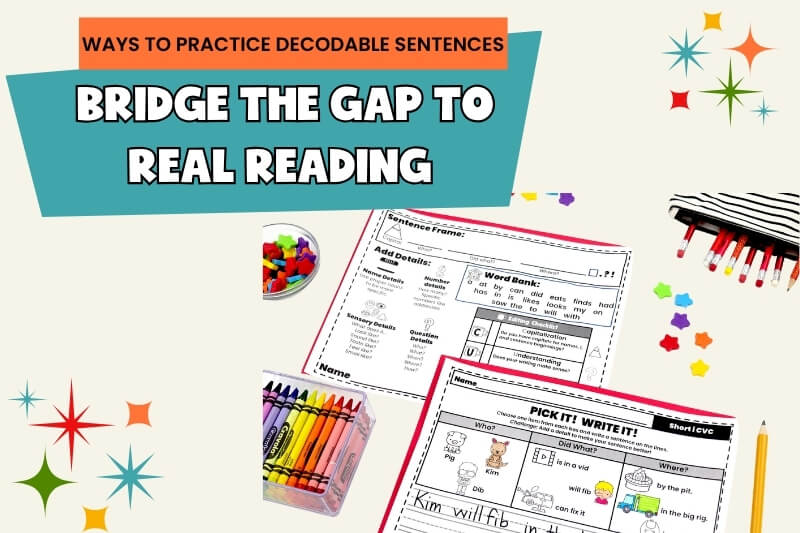
Ways to Practice Decodable Sentences (and Bridge the Gap to Real Reading)
So, for the good news. You don’t need a whole new block of time to fix this. A lot of it is just sneaking more “real” reading into stuff you’re already doing. Here are a few ways that worked for me.
Make your morning message decodable.
If you’re already doing a morning message (and if you’re not, I highly recommend it), this is an easy win. Write it using mostly the sounds and skills your kids have already learned. It doesn’t have to be fancy. “Today is Tuesday. We will read a book about bugs.” That’s it. Kids are reading connected text before the day even really starts, and you didn’t add a single new thing to your plans.
Read connected text daily, even just a little.
This one sounds obvious, but it’s easy to lose in the shuffle. Somewhere in your day, make sure kids are reading actual sentences, not only isolated words or sound cards. A few lines. A short decodable passage. It doesn’t need to be long. It just needs to happen, consistently.
Try writing decodable sentences.
This is the flip side of reading. Instead of only decoding someone else’s sentence, kids build or write their own using the sounds they’re learning. It’s called encoding, and it’s honestly one of my favorite ways to check if a skill has really stuck. (This is where my Pick It! Write It! decodable sentences come in, if you want something ready to go.)
Choral or partner read decodable text.
Grab a partner, grab a page, go. Low prep, easy to fit into a transition or a few spare minutes, and it gets in extra reading reps without you having to plan a thing.
Sneak it into your other subjects.
Math directions. A quick science fact. A line on the calendar. If it’s decodable-ish, kids are practicing without even realizing it’s “reading time.” Every little bit adds up.
No matter which of these you try, the goal is the same. Real reading, not just sounds and words in isolation.
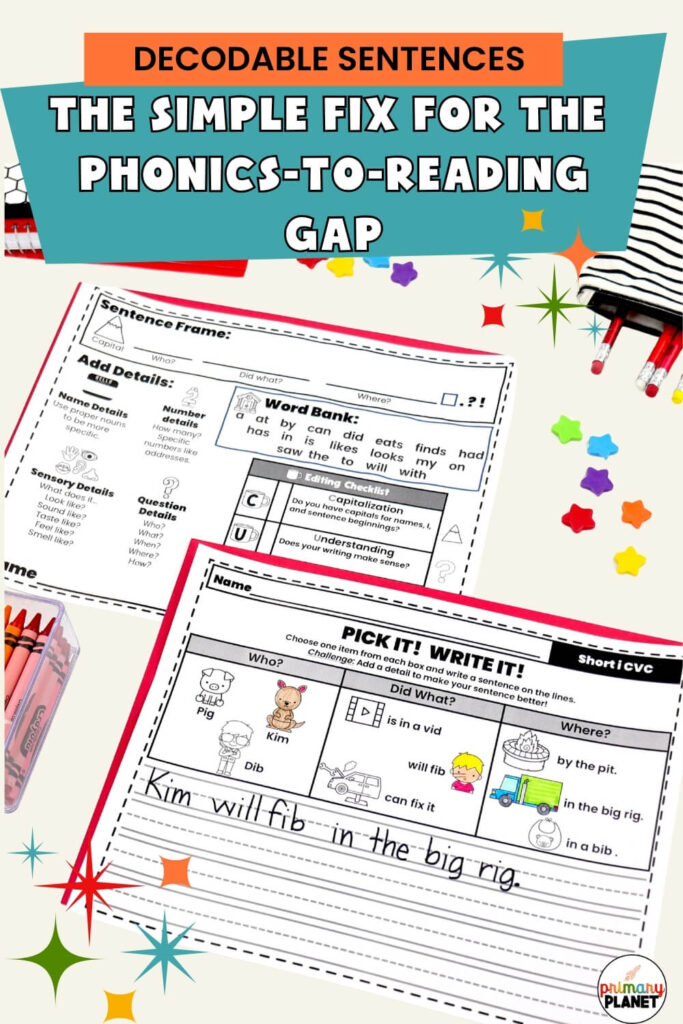
Pin the image above to save this post for later! Sharing is caring!
Want to try a few decodable sentences before you commit to anything? I’ve got a free sample tucked into my Free Resource Library — just click the orange button, pop your email in and it’s yours.
If you want the full set, check out my Pick It! Write It! bundle in my shop.
Follow me on TpT! New products are 50% off for the first 24 hours after posting — you don’t want to miss that. Follow my store here.
Happy Teaching,