

If you’ve ever read a first grader’s writing and hit five short sentences in a row, all starting with “I,” all about the same size, you know the choppy-sentence stage. It’s not wrong exactly. It’s just young. Combining sentences is one of those skills that takes that choppiness and turns it into actual, readable writing pretty fast, once kids have a system for it.

Here’s how I’d walk through teaching combining sentences, one step at a time.
Step 1: Start with two short sentences kids already get.
Keep the content dead simple. “The dog ran. The dog barked.” You want all the brainpower going toward the combining part, not toward reading or understanding the sentences themselves. This isn’t the moment for tricky vocabulary or new content, save that for once the skill is solid.
Step 2: Teach one conjunction at a time.
Don’t hand kids and, but, so, and or all in the same week. Pick one, and is usually the easiest starting point, and stick with it until it feels close to automatic. Adding all four at once just turns into a guessing game, and kids end up picking a conjunction because it sounds fine, not because they understand what it’s doing.
Step 3: Model it out loud before they try it.
Say the two short sentences, then think out loud while you combine them. “The dog ran. The dog barked. Hm, I want to connect these, and they’re both about the dog… I could say, the dog ran and barked.” Let them hear the thinking part, not just the finished sentence. This step is easy to rush past, but it’s honestly where most of the learning happens.
Step 4: Practice that one conjunction for a few days.
Repetition matters here. A few days of and, with new sentence pairs each time, keeps kids from mixing everything together too early. Short, daily practice tends to stick better than one long lesson and then moving on.
Step 5: Bring all four together in a review round.
Once each conjunction has its own footing, mix them. This is where kids start actually choosing the right one instead of just plugging one in because it’s the only one they know. It’s also a good spot to catch who needs more support before you move on to something new.
A couple of things to watch for as kids get the hang of combining sentences:
Kids will sometimes combine two sentences that don’t really belong together, just because they know the mechanics. That’s normal, it usually means they need a bit more modeling with content they understand well before moving to something new. And, watch for kids defaulting to “and” for everything, even when “but” or “so” fits better, that’s usually a sign they need more practice hearing the differences out loud before writing them independently.
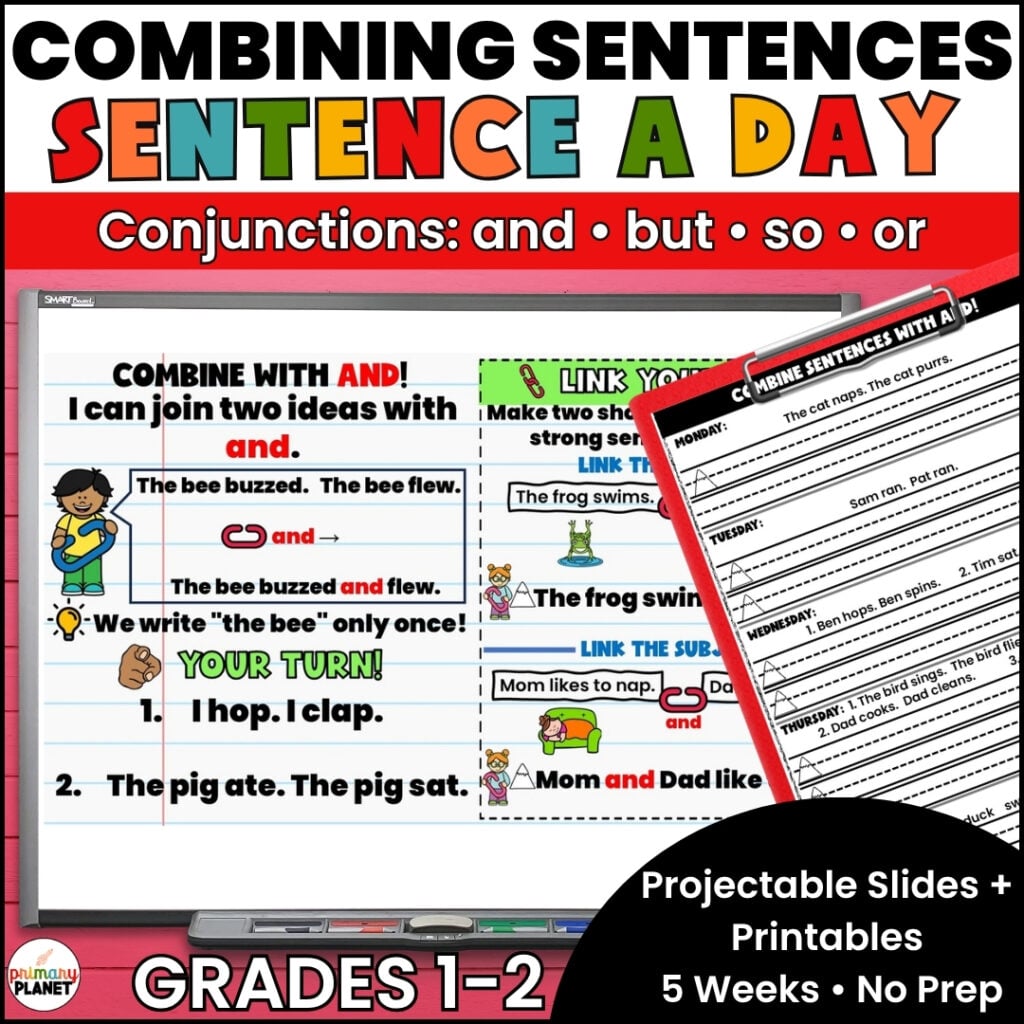
That’s really the whole structure: one conjunction, modeled first, practiced for a few days, then reviewed together. It’s basically how I built my Combining Sentences: Sentence a Day resource, a week for each conjunction plus a review week at the end, if you want the slides and practice pages already made for you.
Once kids have a feel for combining sentences, their writing genuinely sounds older, almost overnight.
TL;DR
- Start with two simple sentences kids already understand
- Teach one conjunction at a time (and, but, so, or)
- Model combining out loud before kids try it
- Practice the same conjunction for a few days before switching
- Review all four together once each one’s solid
- Watch for kids over-relying on “and” or combining sentences that don’t really fit together
Follow me on TpT! New products are 50% off for the first 24 hours after posting — you don’t want to miss that. Follow my store here.
Pin this post if you want to come back to it later. Sharing is caring!

Happy Teaching,