Hey there! If you were like me, teaching vocabulary is one of those things that never really left my lesson plans. When it comes to homophones and homonyms specifically, the challenge isn’t getting students to understand the concept—it’s getting that understanding to actually show up in their reading and writing.
Kids can tell you that homophones are words that sound the same but have different spellings and meanings. Then they go write a story and type “there going to the park” anyway. Getting word knowledge to stick takes more than a lesson. It takes repeated, meaningful practice.
The Real Problem with Homophones and Homonyms
You introduce homophone pairs, students understand the concept during the lesson, and then flour becomes flower in their writing anyway. You teach homonyms—words that share the same spelling or sound but carry different meanings—and students learn that “bark” can mean two things, but struggle to figure out which one fits the sentence they’re reading.
The gap between understanding and applying is real. Worksheets can help, but they don’t always create the kind of active, memorable practice that makes word work worthwhile.
And then there’s the partner-picking situation. You say “Find a partner,” and suddenly three minutes are gone to negotiating, hurt feelings, and at least one student wandering around looking lost.
What if you could solve both problems at once?
Some Solid Approaches First
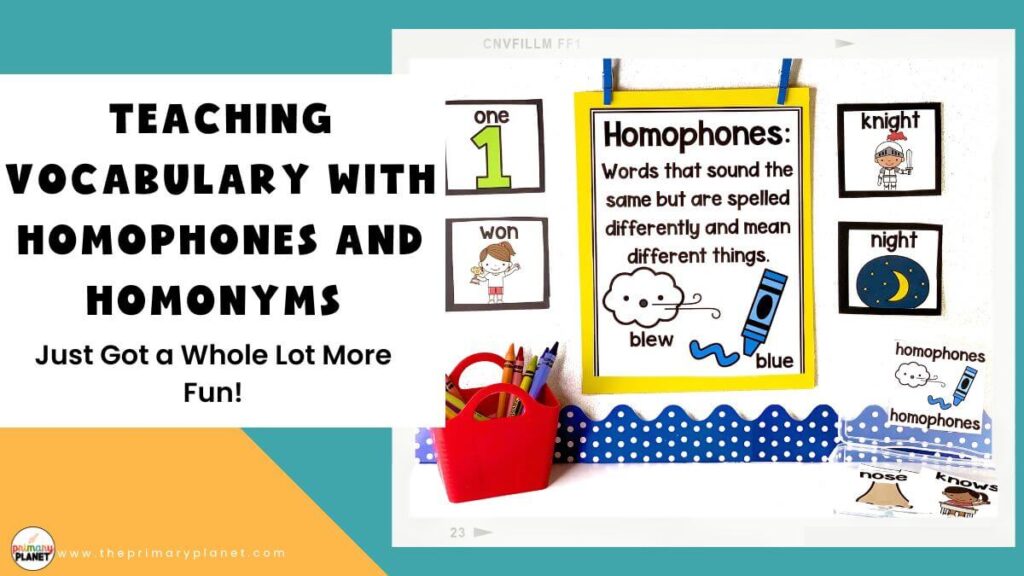
There are several good strategies for reinforcing homophones and homonyms that don’t require any special materials. Reading aloud and pausing to discuss word meanings in context is always a win. Anchor charts with definitions and examples give students a visual reference. Word walls with pictures help connect meaning to sound for visual learners.
Another simple practice that works well: using just one sentence a day, students write a homophone or homonym pair in context. They write the sentence, underline the target word, and try editing it with the other meaning or spelling. Five minutes, built-in review, and it builds editing habits over time. This would be super easy to incorporate into your morning message.
But when you want students moving, engaged, and genuinely applying their word knowledge? Partner pairing cards are where it’s at.
Introducing: Homophone and Homonym Partner Pairing Cards
These two resources from The Primary Planet were designed with exactly that in mind—teaching vocabulary with a purpose, built right into partner selection.
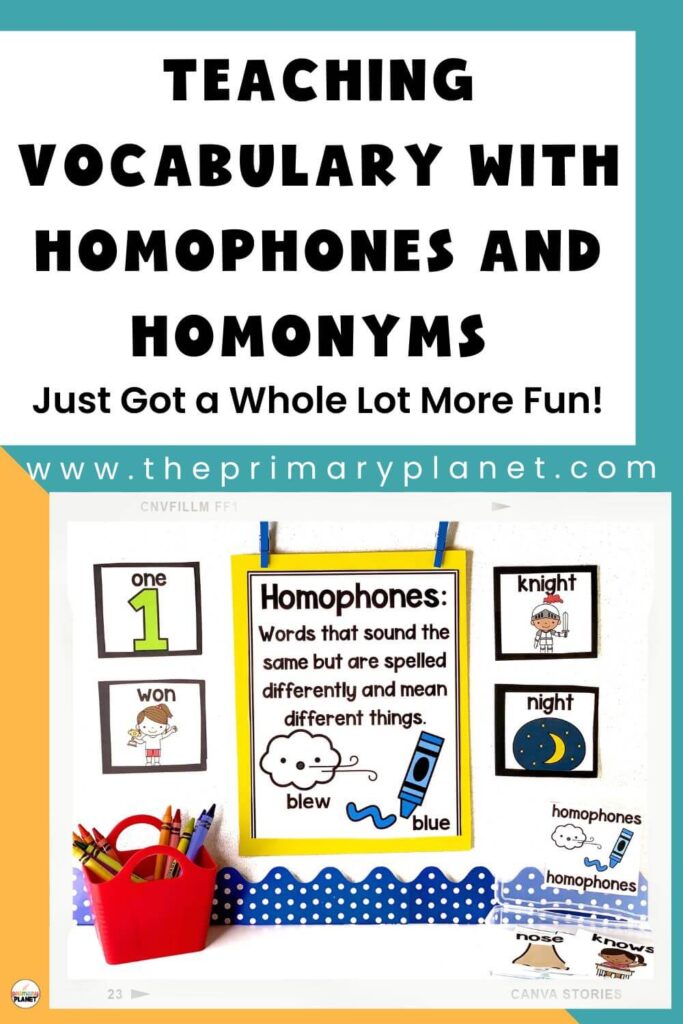
Homophone Words Activity – Partner Pairing Cards ($4.00)
Students each receive a card with a word on it. To find their partner, they locate the classmate holding the homophone—the word that sounds the same but is spelled differently and carries a different meaning. Think ate and eight, bare and bear, flour and flower. The search itself becomes the practice.
Each set includes 15 homophone pairs (30 students paired), cards in both color and black-and-white, a homophone poster, differentiated exit slips, and teacher notes.
Homophone pairs included: ate/eight, bare/bear, ball/bawl, right/write, hole/whole, hi/high, flour/flower, sail/sale, night/knight, mail/male, knows/nose, pause/paws, one/won, pair/pear, meet/meat
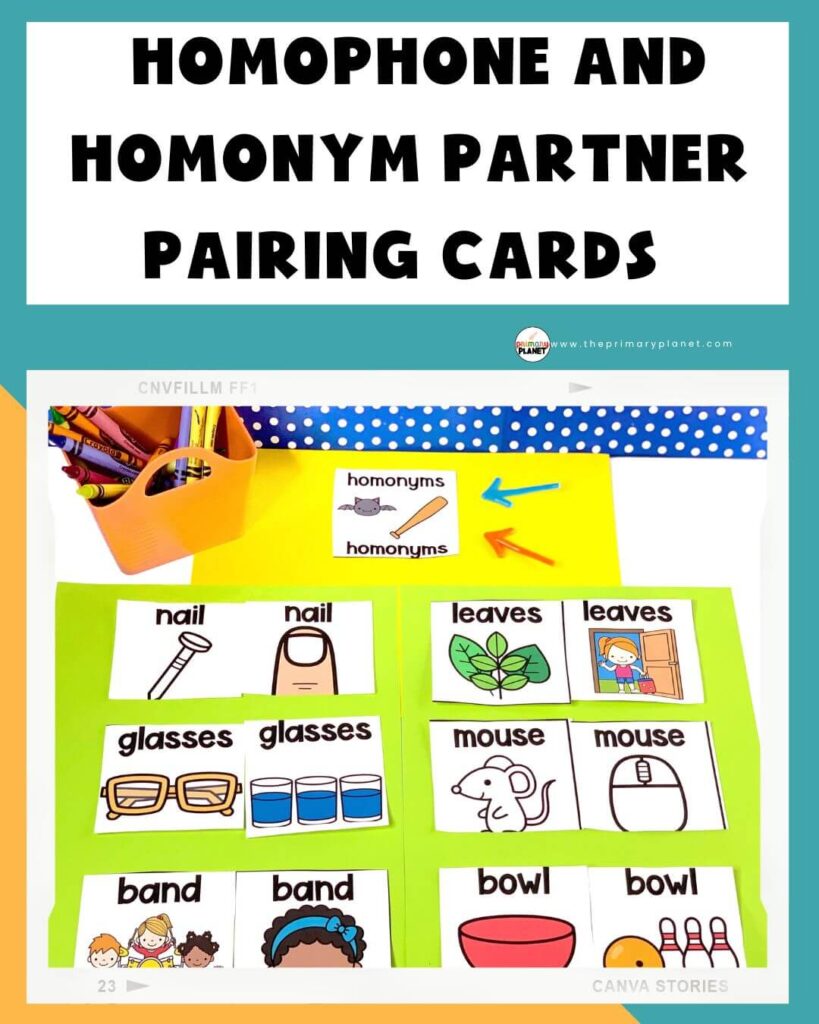
Homonyms Partner Cards – Multiple Meaning Words ($4.00)
Same concept, different focus. Students find the classmate whose card shows another meaning of the same word. A student with “light (not heavy)” finds the student with “light (a lamp).” This makes the abstract idea of multiple meanings concrete and active.
Includes 15 homonym sets (30 students paired), color and black-and-white cards, a homonyms poster with definitions and examples, differentiated exit slips, and teacher notes.
Multiple meaning words included: band, bowl, chip, bark, bow, date, chest, foot, glasses, letter, light, mouse, match, leaves, nail
Both resources can also be used as a Memory/Matching Game for centers or small group instruction, or as a silent matching challenge for a quick brain break.
Homeschool Suggestions
These partner pairing cards adapt well to a homeschool setting, even with just one or two students.
Use the cards as a simple matching activity—lay them all out and have your learner find each pair. Time it and try to beat the previous record. The Memory Game version works great with two players and builds word recall naturally. Exit slips offer a low-pressure way to check understanding and keep a written record for portfolios. A word sort is another good option: give your learner a small set of cards and ask them to group pairs and explain the connection between each one.
Want More Ideas for Teaching Vocabulary?
If you enjoy this approach, check out the full Partner Pairing Cards collection at The Primary Planet. There are also sets for Synonyms, Antonyms, and Compound Words—all built around the same concept of reinforcing word knowledge while pairing students up.
And if you want free resources, tips, and early access to new products, join the Freebie Planet at theprimaryplanet.com/freebies.
Quick Summary
- Teaching vocabulary with homophones and homonyms is most effective when practice is active and repeated
- Daily sentence practice (one sentence, one word pair) builds editing habits without extra prep
- Homophone Partner Pairing Cards and Homonym Partner Pairing Cards reinforce word knowledge while solving the partner-picking problem at the same time
- Both sets include color and B&W cards, posters, differentiated exit slips, and teacher notes
- Cards can be used for partner pairing, Memory/Matching games, or silent matching challenges
- Both resources work well for homophones and homonyms practice in classroom centers, small groups, and homeschool settings
- Each is just $4.00 and ready to use right away
📌 Pin the image below to save this post for later!
Happy Teaching,